A team that
works while you sleep.
TrustyGenius gives energy and commodity teams production AI agents that research markets, monitor risk, process incoming information, and work with the systems your desk already uses. Start with the ready-made quant platform, or deploy an agent around one of your own workflows. Every workspace is provisioned and configured before access, so requirements, data access, and credentials are confirmed with your team first.
Put an agent on the workflow slowing your team down.
Automate the repeatable steps around a valuable workflow, so your team can handle greater volume, investigate more opportunities, and focus human attention where it has the greatest effect.
Bring us one expensive, repetitive workflow. We scope it, connect the required systems, and deploy a production agent. The build itself is AI-accelerated, so a first working version can often be produced in days. Production deployment typically occurs within 30 days, with much of the calendar devoted to scoping, system access, testing, and client sign-off. It arrives with real database state, permissions, human approval gates, and an audit trail, all on the same extensible foundation that powers TrustyGenius.
Investigate market questions, test hypotheses, monitor portfolios, and produce scheduled briefings.
Read a role inbox, extract structured information, enrich it, update internal systems, schedule work, and escalate exceptions.
Connect proprietary data, APIs, models, and internal tools to an agent designed around the way your team operates.
Every sprint is scoped and built directly with Joe, TrustyGenius's founder: around 20 years across energy trading, risk, quant analytics, consulting, and production software, including Deutsche Bank, Merrill Lynch, and Citi.
From incoming request to reviewed action.
A production agent is not a chat window. It is a worker with a database, a toolset, and rules about what it may do on its own and what waits for a person.
A confirmation arrives. TrustyGenius extracts the economics, compares them with the trade database, retrieves the relevant information, flags a discrepancy, alerts the responsible person, and records every step.
The runtime underneath is what the quant platform runs on today: database state, email ingestion, scheduling, notifications, the audit log. A sprint connects it to your systems.
A quant lab that plugs into your own sources.
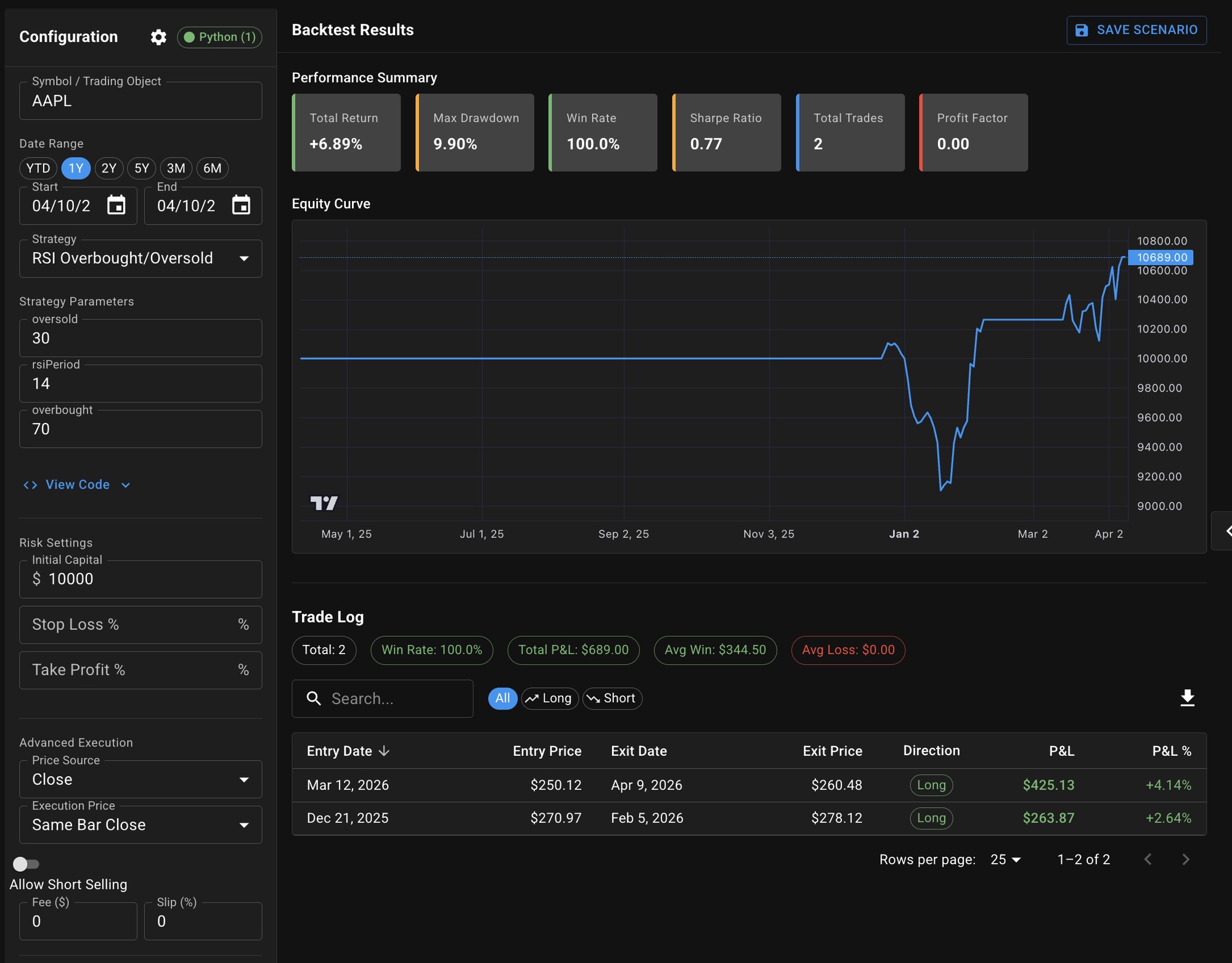
Not another moving-average wrapper. Regime detection, mean reversion, Monte Carlo, walk-forward, storage valuation: the toolkit a desk actually uses, already wired up. This is the proof the foundation works: the same runtime, packaged as a managed product configured around your workspace.


Actual product: backtest results and Monte Carlo simulation.
Any data you can reach.
Any question you can phrase.
Markets are just the start. If a source has an API, you can wire it in and put a Genius on it: watching, cross-referencing, and briefing you when something changes.
A specialist desk,
not a single chatbot.
A little like a brain: not one big mind, but specialized regions working independently. Each Genius runs autonomously on its own schedule, with its own tools and memory, and they share what they learn through a common insight journal, so the whole compounds.
Reads term structure, basis, and seasonality across energy and commodities. Flags when the curve or a spread relationship is dislocating, and what it means for your hedges.
Reads a role inbox, extracts the structured details, updates internal systems, schedules the follow-up, and escalates the exceptions that need a person.
Defends the paper book: position sizing, rolling Sharpe / Sortino / drawdown tracking, limits per strategy and portfolio-wide. Flags any edge whose paper performance decays, so a stale strategy never lingers unnoticed.
These are starting points, not a fixed roster. A Genius is a charter, a toolset, a memory, and a schedule. If your desk has a job, you can staff it.
Explore the Genius model โIt has to make its case.
Every Genius explains its reasoning and shows the evidence behind it. You set the criteria it has to meet, and you can put a second Genius on the work to review it, double-check the numbers, or argue the other side before anything reaches you.
For a trading strategy, that bar is quantitative: Monte Carlo simulation, walk-forward testing, and out-of-sample validation. Nothing graduates on a good story.
Illustrative backtest output: simulated, not real-money returns.
1,000 Monte Carlo paths ยท 5yr history ยท 6mo OOS windows
Validated strategies run on paper.
Research, not execution.
Paper trading with simulated fills is the destination, not a stepping stone: TrustyGenius doesn't place live trades, and nothing it produces is trade advice. Position sizing, risk limits, and correlation tracking stay observable the whole way. The calls stay yours.
Simulated paper position, for illustration.
A team that gets
sharper every month.
It arrives as a working research team, plugged into your data and tailored to your book. And it compounds. The longer it runs, the more it knows about how you trade, with the controls a professional shop expects around anything that acts on its own.
A fast, cheap model routes the mail; a frontier model works the research. One memory underneath: everything the system has learned stays readable by every model, today's and tomorrow's.
When your desk needs a new feed, report, model, or custom capability, an expert can build it quickly, in the same environment the Geniuses run in.
Nothing rests on one model's say-so. A second Genius can review findings before they reach you, and every strategy faces validation gates before it runs on paper. That is the practical answer to hallucination.
Every agent action leaves a trail: tool calls, data reads, decisions, timestamps. Oversight while it runs; a ready-made record if you ever need a post-mortem.
Every series you save, insight you log, and correction you make sharpens it. It knows your book better each month. That is the asset.
Models are swappable: Claude, GPT, Llama, whatever comes next. Your data, memory, and strategies live in one model-agnostic place, so when open-weights models reach the frontier, you're already positioned. Private by construction, isolated at the database layer.
And it's light on its feet: a modest VM runs the whole thing, and the deployment is cluster-native (Docker Swarm, Redis-backed). When one machine stops being enough, growth means adding nodes, not starting over.
Two ways to start.
Choose a guided platform deployment or bring us one custom workflow.
typically 3โ5 business days.
- Full platform: research, validation, scheduled agents, and the paper portfolio.
- 15M AI tokens included monthly. Beyond that, agents pause, or you opt in to metered overage with a cap you set. Never a silent bill.
- Bring your own market data (e.g. your IBKR account as a feed); subscriptions and exchange fees aren't included.
- Research and paper trading only: no live execution, no trade advice.
- Timing begins after scope, required access, and credentials are confirmed.
deployed as an agent.
- One defined business workflow.
- A first working version may take days; production timing is confirmed during scoping.
- Managed deployment, or deployment inside your infrastructure.
- Fixed-scope engagement with an ongoing support and licensing path.
Pricing is based on deployment and scope. Custom agents, integrations, data sources, broker work, and non-standard infrastructure are quoted separately.
This ran today.
It'll run again tomorrow.
Working for you, learning your book, with data that stays yours.
Partner with me to shape it, or adopt it for your own work.